
Hive Interview

The £1,000 Camera That Never Arrived: Panasonic on the Cost of Delivery Failures
Lost parcels and no-show collections cost retailers money and customer trust. Panasonic's Gavin Parker explains how to fix the last mile.

Vivek Gulati - The Retail Hive

Gavin Parker - Panasonic
What happens when a high-value product disappears in transit, or a customer takes the day off for a collection that never happens? For Gavin Parker from Panasonic, tackling parcel losses and unreliable collections is a pressing logistics challenge. He joins The Retail Hive’s Vivek Gulati to discuss carrier accountability, smarter routing and why giving customers more choice could help solve the problem.
"I don't just want to know that something has gone missing. I want to understand why and what we're going to do about it."
Vivek: If you could send up a flare about the biggest challenge you’re facing right now, what would it be? What’s keeping you awake at night?
Gavin: Two things, really: losses and collection services.
We’re seeing high-value products going missing in transit, and the biggest frustration is the apparent lack of interest from carriers in investigating what happened.
When you lose a £1,000 camera, that’s a significant cost to the business. But where has it gone? I don’t just want to know that something has gone missing. I want to understand why and what we’re going to do about it.
The other big challenge is collections for returns. We’re not getting the level of service we need.
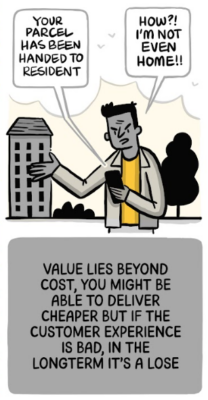
A customer might take a day off work to hand something over to a driver, only for the driver not to turn up, or to claim they’ve attempted a collection when they haven’t.
When that happens three or four times, understandably, the customer gets upset. It’s a poor experience, and we’re left trying to resolve it.
"What frustrates me more is when products disappear within the carrier network and there doesn't seem to be enough effort to understand why."
Vivek: With the missing products, how much of the problem is genuine loss and how much is fraud?
Gavin: It’s both.
Sometimes an item genuinely goes missing. Other times, you have customers trying to pull a fast one.
With fraud, at least you have some opportunity to investigate. Over time, you get to know the different methods people use and the warning signs to look for.
But you have to be very careful. If you challenge a customer because you suspect fraud and it turns out they’re telling the truth, you’re putting your reputation at risk.
It’s a difficult balance.
What frustrates me more is when products disappear within the carrier network and there doesn’t seem to be enough effort to understand why.
Are losses concentrated in particular locations? Are certain depots experiencing more problems than others? Are there trends that could help identify what’s happening?
We need carriers to investigate those questions and take action, rather than simply accepting that losses are part of the operation.
"With a dedicated carrier management system, we should be able to set more detailed parameters. For example, we could automatically route higher-value products through a particular carrier or service, while using a different option for lower-value items."
Vivek: So what’s the solution? Are you looking at changing carriers or finding different ways to protect those higher-value products?
Gavin: We’re exploring a few options.
One is moving some of our higher-value products to a different carrier. That might cost us more per delivery, but if it means those products arrive safely, the overall cost to the business could actually be lower.
We’re also exploring things like PIN-verified delivery to provide an additional level of security.
At the moment, though, our options are fairly limited by the way we manage carrier allocation.
We don’t currently have a dedicated carrier management system. Routing decisions are handled within our ERP, which restricts how easily we can change carriers or apply different rules to different shipments.
That’s something we’re investing in, and hopefully we’ll have a more flexible system in place next year.
Vivek: What difference will that make in practice?
Gavin: It should give us much more control over which carrier we use for a particular shipment.
At the moment, our routing decisions are largely based on volume and the number of pieces. We don’t really factor in the value of the goods and that’s something we need to change.
With a dedicated carrier management system, we should be able to set more detailed parameters. For example, we could automatically route higher-value products through a particular carrier or service, while using a different option for lower-value items.
It should also make switching between carriers much easier.
And it’s not just about parcel deliveries. We’re managing full loads and part loads as well, so we need to understand the most efficient option for different shipment sizes and destinations.
Those breakpoints can vary by postcode. A more dynamic system should help us make better decisions across the whole operation, rather than relying on the relatively limited rules we have today.
"I can see the potential for things like data analysis, particularly when you're dealing with large amounts of information about carrier performance."
Vivek: Are you looking at AI or other emerging technologies to help manage carrier performance and make sense of all that data?
Gavin: We’re definitely starting that journey as a business, although personally, I’m probably a bit old school!
There’s a growing desire within Panasonic to make more use of AI. Later this year, everyone will receive some basic training on how to use it, and I expect we’ll see it become more integrated into our day-to-day work over the coming years.
I can see the potential for things like data analysis, particularly when you’re dealing with large amounts of information about carrier performance.
As we develop our systems and our understanding of AI, there should be opportunities to use it to support some of those decisions.
Vivek: And what about collections? Could giving customers more choice help solve some of those service problems?
Gavin: That’s exactly what we’re exploring.
At the moment, customers can be very dependent on a carrier turning up at their home at the right time. When that doesn’t happen, it creates a lot of frustration.
We’re looking at whether we can offer alternative collection methods, including allowing customers to drop products off at a convenient location rather than waiting for a driver.
That could mean giving them a choice of carrier or finding a drop-off point that’s closer to home and easier to use.
Parcel lockers are one option, but they aren’t suitable for everything we sell.
A camera or smaller electronic product might fit in a locker, but a television or microwave certainly won’t.
So we need solutions that work for different product types. One option we’re exploring is using Royal Mail’s network of drop-off locations, which could make it easier for customers to return items without having to arrange a home collection.
The important thing is giving people more flexibility.
If we can remove the need for customers to wait at home, we can improve their experience and reduce our reliance on collections that don’t always happen as planned.
Ultimately, that’s what we’re trying to achieve across the operation: fewer losses, more reliable service and better options for our customers.
"If we can remove the need for customers to wait at home, we can improve their experience and reduce our reliance on collections that don't always happen as planned."
KEY TAKEAWAYS
Carriers need to investigate losses, not just accept them.
Route by product value, not just volume.
Legacy systems limit flexibility.
AI is on the horizon, not yet in practice.