



Search and discovery feels like it’s in flux right now. Most teams can sense that something has shifted, but there isn’t a silver bullet to solving everything today.
Some are still refining what they have, improving keywords, navigation and on-site journeys. Others are experimenting with personalisation, intent signals and AI-driven experiences. A few are starting to think more radically about what happens when discovery moves off-site entirely. The result is a landscape where everyone and everything is changing as a result of the significant acceleration in AI innovation.
What’s clear is that the centre of gravity is changing. Customers are becoming more comfortable expressing intent in natural language, expecting faster, more relevant outcomes, and increasingly discovering products before they ever reach a retailer’s site. The result is a widening gap between what shoppers expect and what retailers deliver.
Progress is happening, but it’s uneven. Some capabilities are advancing quickly, others are held back by data, structure or internal complexity. Underneath it all, there’s a growing sense that today’s model won’t stretch far enough to meet what’s coming next.
The direction of travel is becoming clearer, even if the route is not. Over time, these different approaches will start to converge around more intelligent, intent-led and increasingly agent-driven discovery. The question for retailers is not whether that shift will happen, but how quickly they can position themselves to benefit from it.

Search Wasn’t Built For Intent
Ed says: “Retailers can feel the shift before they can articulate it. The old model still works just enough to keep things moving, but behaviour has already moved on. Customers are starting to search with intent, not keywords, and increasingly they’re doing it outside your ecosystem. The gap between how customers discover and how we’re set up to serve them is where the pressure is building, and that gap is only going to widen over the next 12–18 months.”
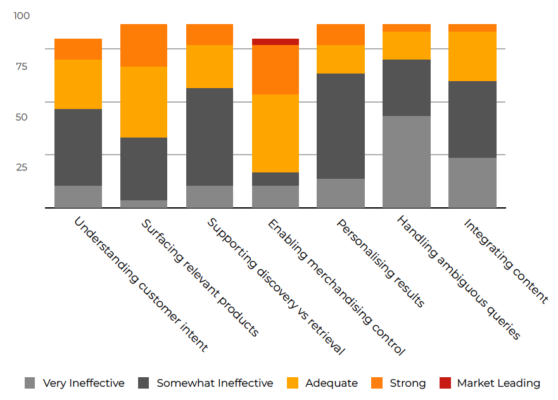
 “Search today is not where we want it to be. It’s messy, because of the complexity across countries, languages and channels, and that makes it hard to keep things consistent. We’re simplifying where we can, but it’s still a balance between managing scale and actually delivering something that feels intuitive for the customer.”
Elena Cardellini, Director, Digital Commerce and Growth, Expondo
The Risk of Moving Too Slowly

How likely are you to review or upgrade your search and discovery capabilities in the next 24 months?
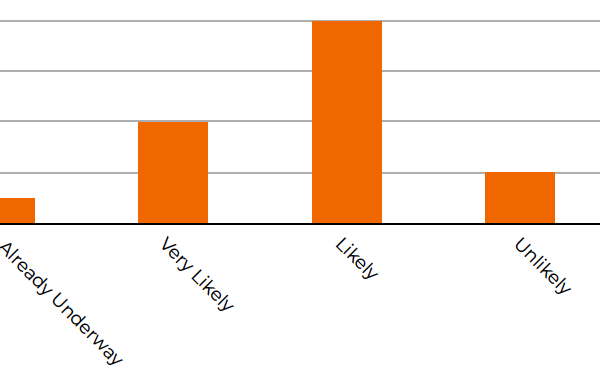
Most teams already know their current setup won’t get them where they need to go, but the route forward still isn’t clear. That’s why so many retailers describe investment as “likely” rather than “underway”. The direction is understood, but execution is still evolving.
What is becoming clearer is that agentic search and AI-assisted shopping are already changing how customers discover and evaluate products. Delivery promises, stock visibility and fulfilment flexibility are starting to shape the discovery journey itself, not just the checkout experience.
The retailers pulling ahead are treating this as a learning phase, testing quickly, strengthening data foundations and building confidence as customer behaviour shifts. The risk for everyone else is death by indecision while the benchmarks quietly move around them.
What’s Holding You Back?
 “Search is going to be less about rankings and more about making sure your content is structured in a way that AI can pick up. Things like expertise, experience, authority and trust – those E-E-A-T signals – are becoming increasingly important. For us, it means focusing on things like FAQ pages, making them really concise and using bullet points so generative engines can read them easily. We’re leaning heavily into that.”
Bryony Tagg, Head of eCommerce, Chilly’s
What is the single biggest limitation of your current search and discovery setup?
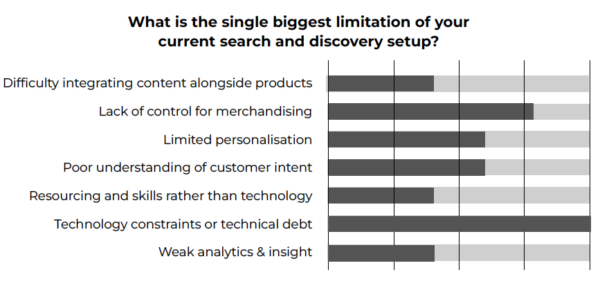
The Foundations Are Constrained
Ed says “Most teams aren’t failing because they lack ideas. They’re constrained by the shape of what they’ve already built. You can
optimise within that, but you can’t fundamentally change it, which is why progress feels incremental when the market is moving exponentially. The real unlock comes when teams stop trying to stretch legacy frameworks and start thinking about retrieval, data structure and intent as the foundation. That’s what determines how far you can actually go.”
Which of the following best describes how your search experience is currently powered?
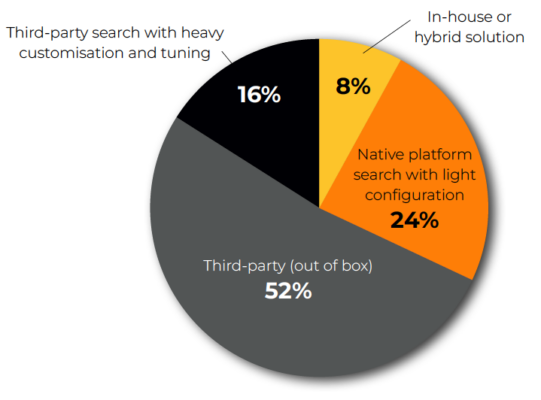
AI Is Coming But Not Quite Yet
Where are you actively investing, experimenting or planning to invest in the next 12–18 months?
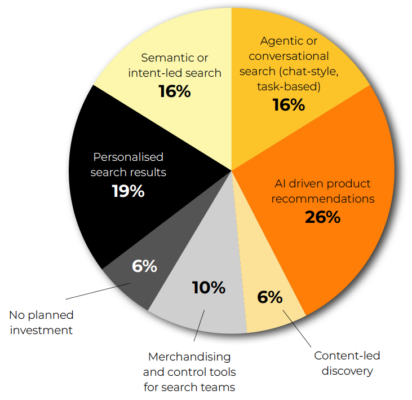
 Investment is at risk of spreading across too many fronts because no one wants to back the wrong horse. Personalisation, semantic search, recommendations, conversational interfaces: all moving, none fully landed. The danger is doing a bit of everything and mastering nothing. The advantage right now goes to teams that pick a lane and go deep, especially around intent capture and retrieval, because that’s what everything else will plug into. Get that right and you create optionality. Get it wrong and you’re constantly layering complexity on top of weak foundations
Discovery is Moving Off-Site
Ed says “The biggest shift isn’t on the site, it’s before the site. If discovery is happening elsewhere, your job changes from guiding the journey to being selected at the end of it. That means product data, availability, context and trust signals all become part of how you compete. The winners will be the ones who make their products easiest for agents to find, understand and trust, not just the ones with the best on-site experience.”
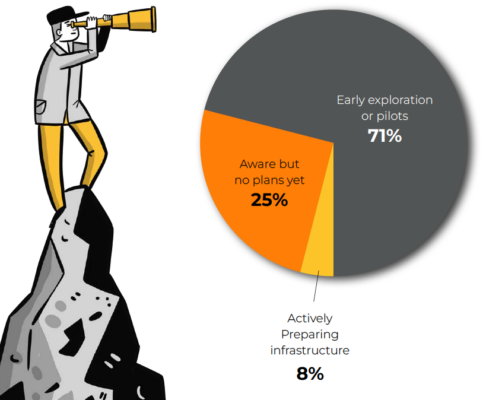
How prepared do you feel for customers using AI tools (agents, assistants, chat) to interact with or navigate your site on their behalf?:
What this means for retail leaders
John Stewart, VP, Corporate Communications, Algolia
Retail discovery has entered a new era. Consumers now expect experiences that understand intent, adapt in real time, and connect seamlessly across every channel and interaction. At the same time, AI is rapidly reshaping how products are found, recommended, and purchased.
Retailers broadly recognise where discovery is headed. The challenge is execution. Those organisations that modernise their discovery infrastructure, operationalise AI, and empower teams to move faster will define the next generation of digital commerce. Those that delay risk falling behind with fragmented experiences and legacy systems built for a very different retail environment.
The mandate for retailers is clear:
1. Adopt intent-driven discovery: Use AInative search that understands meaning, context, and shopper intent through semantic and hybrid retrieval.
2. Deliver real-time personalisation: Continuously adapt experiences using live behavioural signals, in-session activity, and dynamic relevance optimisation.
3. Unify search, browse, and recommendations: Create a connected discovery experience that seamlessly blends products, content, navigation, and recommendations.
4. Empower teams to optimise at speed: Enable merchandising and business teams to manage relevance, launch campaigns, experiment, and iterate without engineering dependency.
5. Build an AI-ready foundation: Invest in API-first infrastructure, high-quality data, and unified analytics to support scalable, AI-driven discovery across every channel.